
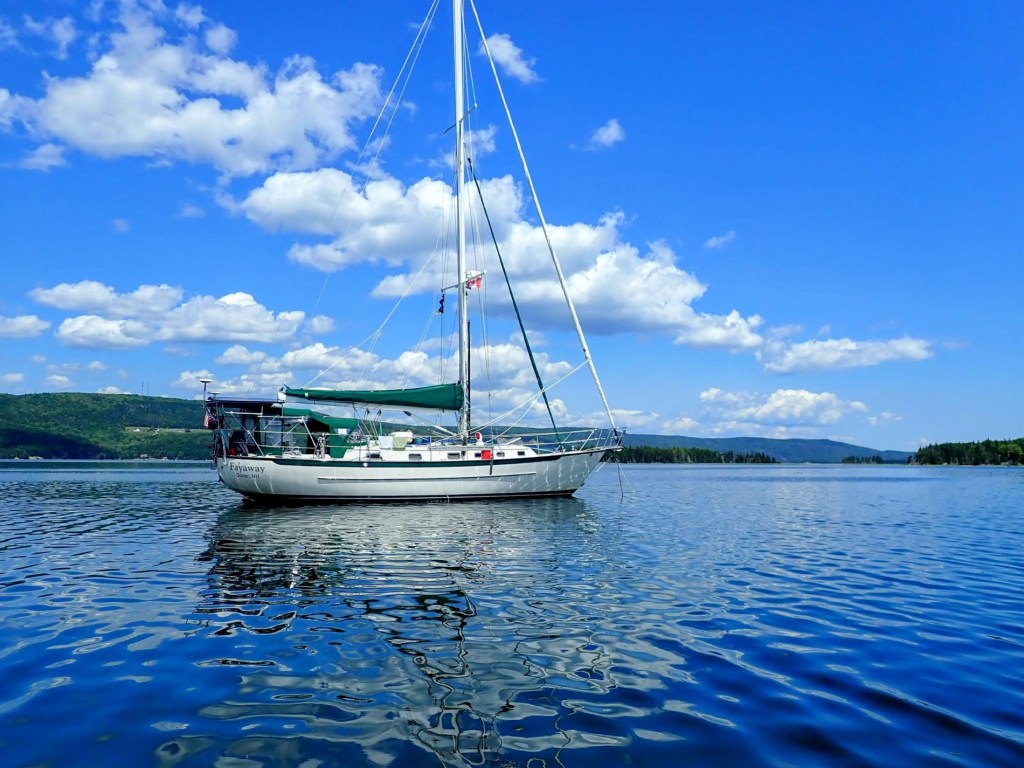
Fayaway is currently entertaining her crew while bopping around the Bras D’Or Lakes region of Cape Breton Island, Canada. Between reports of regional highlights I’ve been working on a few drafts of practical boat stuff, hoping that you enjoy some of this too. Note that I’ve filed in the “Upgrades and Installs” category.
Three years ago we purchased Fayaway together with a Max-Prop feathering propeller – actually with a loose bin of Max-prop, gathered from the seller’s garage for 15 years. Literally in pieces, we found most parts coated with mild corrosion, and the inner bits not corroded were protected (plastered) with sticky caramelized grease, topped with a layer of animal hair for good measure. Yum. Perhaps the prior owner used a chisel and power tools to remove whatever barnacles had been permanently stuck to the blades. It was a mess, but still had some life.

We carefully cleaned, reassembled, lubed and adjusted for the proper pitch settings. We paid the yard guys to double check that my settings are appropriate before launching. However, the sadly neglected prop was worn, jiggled a bit in its races, and so after a few hundred hours of motoring and upon returning from the Caribbean last year we knew we must address the issue.

I looked into rebuilding the original prop. Its manufacturer, PYI, still builds them, and purportedly offers a reasonable price to do the rehab. However, that cost can vary widely depending on the extent and type of wear. Just need to ship it to Washington state and hope for the best. Perhaps there’s another option? Time for more research, and maybe an upgrade opportunity.
Now for boring pseudo techie stuff…
I’ve seen three general types of sailboat propellers, with varying quantity of blades:

1. fixed-blade (efficient at one speed, cheapest, most-reliable);
2. feathering or folding (single-speed efficiency, least drag while sailing);
3. automatic-pitch (most-efficient at any speed and low drag).
A propeller’s blade pitch refers to how aggressively it bites into the water. Water speed, shaft rotation speed, motor power curve, blade shape and pitch all effect how efficiently engine power is transferred into the water. The first two types of props mentioned above employ a fixed pitch setting, and therefore are typically set for highest efficiency according to the motor’s highest power, which is also usually peak motor speed (aka revolutions per minute (rpm). However, when motoring or motor-sailing long distances, the actual motor rpm is typically much lower than maximum. How often do we need peak power? The normal assumption is that the prop’s operating efficiency is quite diminished for greater than 99% of its lifetime, at the benefit of actually needing to goose the throttle on very rare occasions. (But it can happen!)
What if a propeller could offer maximum efficiency at any speed or load? But that means it also can provide the maximum engine power when it’s really needed?
I studied several reviews for various prop designs, including one from Practical Sailor magazine, and of course whatever was available from online forums. I recalled seeing Brian Trautman maintain a unique prop on his famous ketch SV Delos (without endorsement) and had also heard about it again on a sailing podcast – Brunton’s Autoprop.
Brunton, the British manufacturer, claims that its self-pitching prop constantly maintains optimal pitch, and therefore ultimate efficiency, at any speed. It also feathers, reducing drag while sailing. Sounds like an optimal solution!? (Source graphics: Brunton’s website – link above).
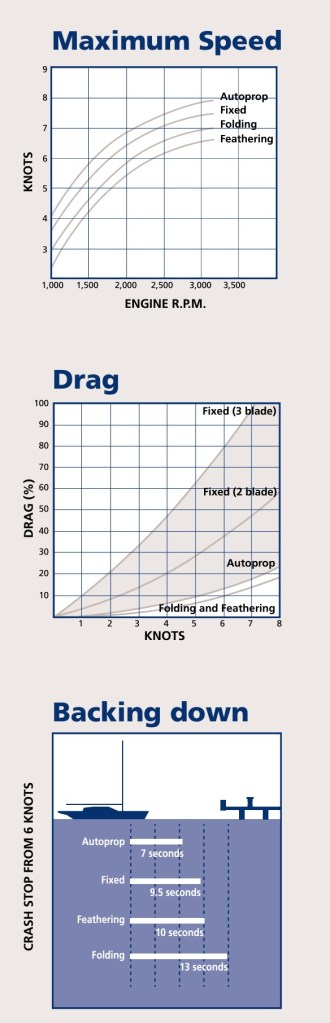
Autoprop is an odd-looking device, that adjusts pitch balancing centrifugal force with the pressure and velocity of water rushing into it. Its lobes resemble floppy dog ears that rotate independently on bearings, but without gears.

However, the stubborn skeptic in me holds me back from buying such sales hype without more review. So, I spoke directly with Brunton, and then other prop companies at the Annapolis Sailboat Show last fall, challenging their crack sales to provide any competitive cons on the Autoprop or other prop concept, (and perhaps taunt me with a price break). I mentally filtered the usual sales blah blah, yet no foolproof evidence arose on all counts. I telephoned Steve Brody the knowledgeable owner of Pacific Seacraft in Washington, N.C. for his opinion. He said he’s heard of Autoprop but they’d never installed one on any of their boats. Desperate for any other input, good or bad, I contacted other Pacific Seacraft owners. They employ either the ubiquitous Max-prop, or a simple fixed blade model “for reliable performance”.
I procrastinated for a few more months, digging for any clues, and somewhat still on the proverbial fence of propellers, while keeping a nervous eye on the approaching Spring launch calendar. One last concern remained: given that Pacific Seacraft nor any of their customers have tried the Autoprop, will the newfangled propeller fit on our boat? Via more than a dozen emails and phone calls, and my barrage of skeptical inquisition, the dealer (AB Marine) shared willingness for attention about the fit onto Fayaway. I appreciated their healthy concern, and not just trying to push a sale). Once made to order, there could be no return.
I again measured, shared photos, and re-measured again… and found no reason to think that it would not work.
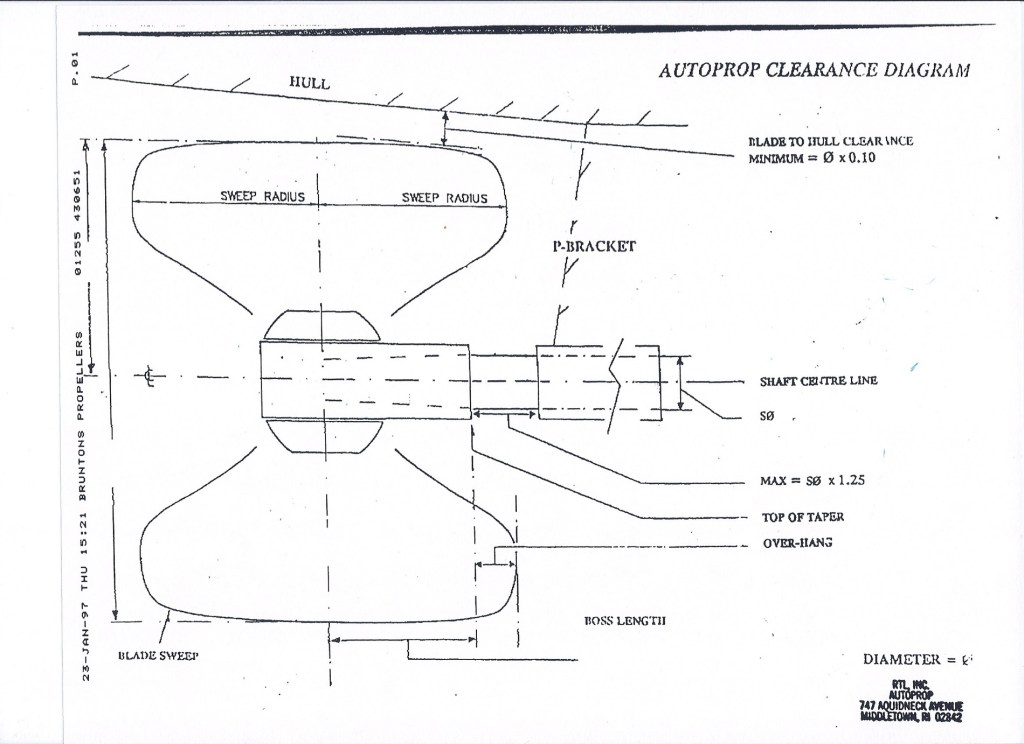


Eventually we reached a decision milestone, we took another leap into the abyss of uncertainty, warmed up the Visa card to and doled out several more boat bucks. Now the wait… for the package to arrive, and for warmer weather at the boat yard.
Approximately two months later…
A quick trip to Harbor Freight afforded a simple prop-puller (to remove old max-prop), and from that point became simple to dry-fit our new floppy gadget. Fingers crossed. Drum roll…
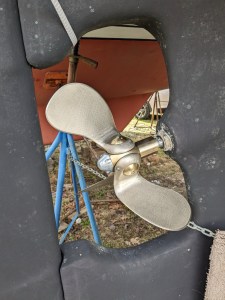
Come look Kelly! It fits!
We have an appropriate amount of clearance within the aperture. Breathing healthy initial relief, I carefully finished the installation per Brunton’s simple instructions, drilling a relief in the nut, applying Loctite for the small locking screw, and attaching a clean new zinc. No greasing or adjusting necessary.
Impressions after initial docking, anchoring and motoring more than 75 hours:
1. Definitely more thrust at lower rpm. For example, now we can motor more easily at 1500 rpm, while making 5.5 knots (in calm seas and minimal windage). Generally, I can now use lower rpm (sometimes to the point of almost idling) while motor sailing in certain conditions, where before would run higher, (presumably less-efficient rpm).
2. Fuel consumption is markedly reduced. According to our fuel log, for the prior four tank refills last year (total = 131 gallon) used as a measure of hourly fuel consumption, we consumed at an average rate of approximately 0.72 gallons per hour (gph). Since installing the Autoprop, we’ve topped off twice, whilst sailing to Nova Scotia (consuming 37.5 gallons) indicating an average of 0.51 gph. That’s an incredible 29% improvement.
Note that this result is preliminary, and assumes we’re running the same average water speeds, sailing techniques, etc. I’m thinking that a larger proportion of recent motor-sailing has been downwind. So, let’s continue keeping track.
Some basic math: Let’s be reasonable and consider a lesser improvement. If we achieved a 20% benefit, it’s like going 20% further on our fuel capacity. Considering Fayaway’s 145 gallons of fuel capacity, at

145g / 0.72 gph = 201 hours; @ 5 kts = 1,000 nm.

compared with a 20% gain:

145g / 0.58 gph = 250 hours; @ 5 kts = 1,250 nm.
3. Reversing? I perceive marginally reduced thrust at a given rpm, but nothing more than can be made up with a bit more throttle. Prop-walk? Not sure it makes any difference yet – this boat steers terribly in reverse.
4. Sounds? A weird hum. Hard to describe, but a strange whirring noise, possibly described as what cavitation would sound like. Changes pitch with speed. there’s also a noticeable “clunk” when shifting to forward from neutral or reverse. At first I was concerned that something was coming loose, but forums say this clunk is normal and common with Autoprop. (Maybe from the blades flipping around??)
5. One disappointment is that the rather small zinc provided was completely dissolved after only two months. Fortunately, we have spares, and the water here in Bras D’Or is warmer.

In summary, there’s obvious improvement in thrust and fuel economy, but dissatisfaction with zinc consumption. And let’s not forget the high cost for initial purchase. For anyone considering a new prop, and considers long-distance fuel economy a priority, do check out the Autoprop option.

 SV Fayaway
Surprised by the zinc consumption
LikeLiked by 1 person
As were we! We had this issue checked before, as the Maxprop, while lasting longer, had a life issue as well. Tests showed normal (aka acceptable) current leakage. But I have a remedy… We drop a grounded sacrificial zinc overboard while anchored, to take up some of the leakage
LikeLiked by 1 person
Have you considered any other recent modifications as possible causes? Without a previous benchmark, and where the prop is not the only addition, could there be other electrical contributors to the increased electrolysis?
LikeLike
Yeah, good suggestion but no, I haven’t modified anything that could conceivably affect the rate. I think the primary culprit is that the new zinc is smaller.
LikeLike
Could it be the Canadian exchange rate?? 😉
LikeLiked by 1 person