
We reached the decision point, while on a brisk sleigh ride ENE. Seemingly non-intuitive, we decided to exit the Gulf Stream while riding along at a respectable 8 knot clip. It didn’t feel right. However, to avoid getting slammed by yet another northerly around Cape Hatteras we cut diagonally across the Gulf Stream speedway on a rum line north toward Beaufort, NC, and into the ICW (IntraCoastal Waterway).

Later on that day our engine failed – sort of: The motor ran but a welded elbow section of exhaust manifold separated, spewing scorching sooty fumes into the engine compartment, into our breathing space and most seriously, potentially could have soon flooded the boat with raw salty water.
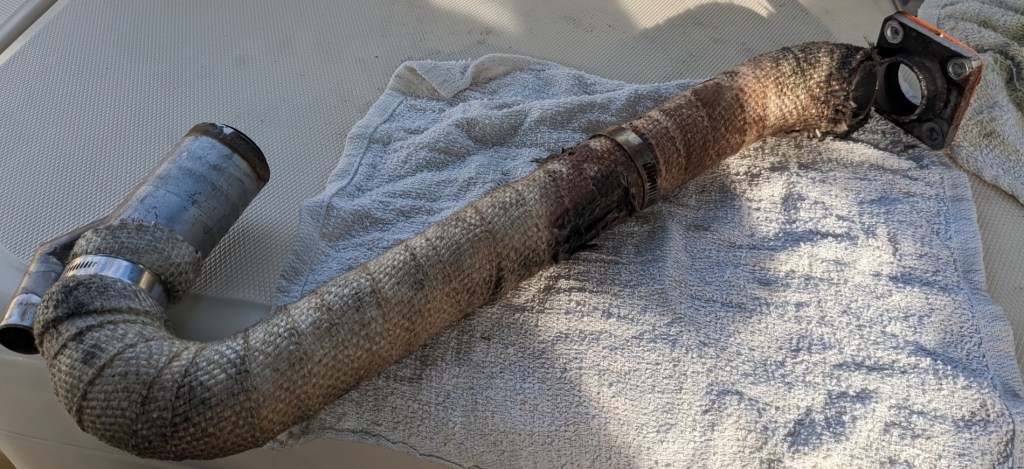
Fortunately, the decision to approach shore was a good one after all – at the time of failure we were a scant two miles from a marina with competent mechanics. Talk about good luck! (How’s that for the glass is half-full thinking?) Such are the ups and downs of vagabond boat life.

But what if a failure happened out on the ocean? Perhaps not such a large problem in that case – we have sails! (And if no wind: beer cans and hose clamps will also work.) A bigger issue is traveling in a narrow inland waterway, often squeezing between swiftly-moving barges, monstrous cabin cruisers, narrow bridges and shoaling channels. Yes, sailing remains possible in the ICW with patience and able hands allow, but with increased risk of causing unrelated issues, especially grounding. We had hoped to never use our towing insurance, but we had it, and so were fortunately tied safely at a dock.

I am not a big risk-taker – at least from a living-on-the-ocean perspective. We’ve spent beaucoup bucks essentially to prevent failures, such as replacing a functional-but-maybe-a-little-tired engine with a brandy new one. We’ve recently replaced or rebuilt many critical bits on this ship – valves, hoses, pumps, motors, rigging, sails, wiring, etc. An exhaustive list of components that could sink or leave us stranded have at least been recently and thoroughly inspected.
WhatsApp inquiry from a fellow cruiser, another Salty Dawg: He was somewhere in the remote eastern Bahamas, and had blown a 3-amp fuse. He jury-rigged a bypass as a temporary fix providing power to all his navigation instruments, but was hoping that a fellow cruiser might have a spare. Fayaway to the rescue! Yup, we had a spare, and are happy to help out.
Spares, spares, spares! You can’t carry enough! Our main concern is being anchored or offshore at a very remote, foreign country, and attempting to locate a critical part for an important piece of our boat. Imagine not knowing the local language, and perhaps the mailboat only visits once per week, or month! But you can’t carry a spare of everything!

So how could our simple yet debilitating engine exhaust failure have been prevented?
Should we have carried a spare exhaust manifold? We think not. But it’s a lesson in further maintenance and pre-checking. Loose bolts? Strange engine vibrations? Better get them checked out before you leave!

Is this enough? But how many extras are enough? We ask ourselves, “What major systems can’t we live without?” Engine? Watermaker? Rigging? Lighting and communication? Steering? Then trickle this up to what parts or supplies are critical for each of these systems to remain operational? And what is possible to replace ourselves? Which would you choose?
Boring stuff: Some spare parts and maintenance items we carry (for the engine) – feel free to skip ahead!
- Alternator (qty 1)
- Starter (1)
- Fuses & relays (at least 1 of each size and type)
- Oil & air filters (at least 3 of each)
- Fuel filters (engine) (3) & (Racor) (At least 12)
- Fuel pump (1)
- Raw water pump – complete (1)
- Raw water impellers (3)
- Antifreeze/coolant (1 gallon- concentrated)
- Crankcase oil – (5 gal; 2.5 gal/change)
- Transmission fluid (2 qts)
- Serpentine belts (4)
- Zincs – heat exchanger (5)
- Thermostat (1)
- Various fuel lines and hoses of various lengths
We also carry many, many non-engine specific spare parts for other systems. It’s an exhausting list! And of course, we usually have a few beer cans too.

Another example: Associated with the exhaust failure, the sooty fumes clogged up the combustion air filter, which we had recently replaced according to the engine manufacturer’s maintenance schedule. Fortunately we carried two more spare air filters. You just never know!
How much is enough? Since it’s usually just the two of us on multi-day passages, Fayaway’s primary steering needs to be robust. A massive skeg captues the rudder at its lower end. Heavy bronze gears and ball-joint linkages couple the wheel to a beefy rudder shaft quadrant. Cables cannot fray or wear out because there aren’t any, and almost no detectable play exists between wheel and rudder. If that primary system fails, we have an emergency tiller that couples directly to the rudder shaft. We also installed a new hydraulic autopilot drive, sized for a larger and heavier boat, and kept the original (still-working and high-quality) as a spare. Our course computer, GPS antennas, compasses and displays are redundant, so if one component fails, another is automatically in place to take over. As if that wasn’t enough, we have an entirely -independent mechanical wind vane self-steering apparatus, that uses its own rudder.

What can’t you live without?
Kelly likes her water: we have two main tanks holding 120 gallons, a 5-gallon gerry can and two one-gallon jugs. A Spectra 8 gph 12v watermaker is powered by redundant solar arrays. Somewhere nearby is an offshore rebuild kit, with all valves, seals, o-rings, etc, and at least a dozen sets of filters: 20 and 5 micron, as well as carbon for purging. If one of the two pressure pumps fails, we can swap them or use one of two foot pumps. If the watermaker electronics fail, we can run it manually.
Life aboard and in remote places is ok when things break – they always do. As long as you have the spares and tools, there’s no need to worry!
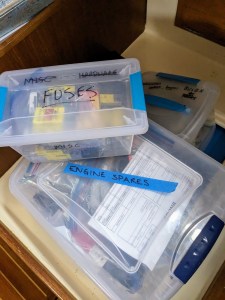
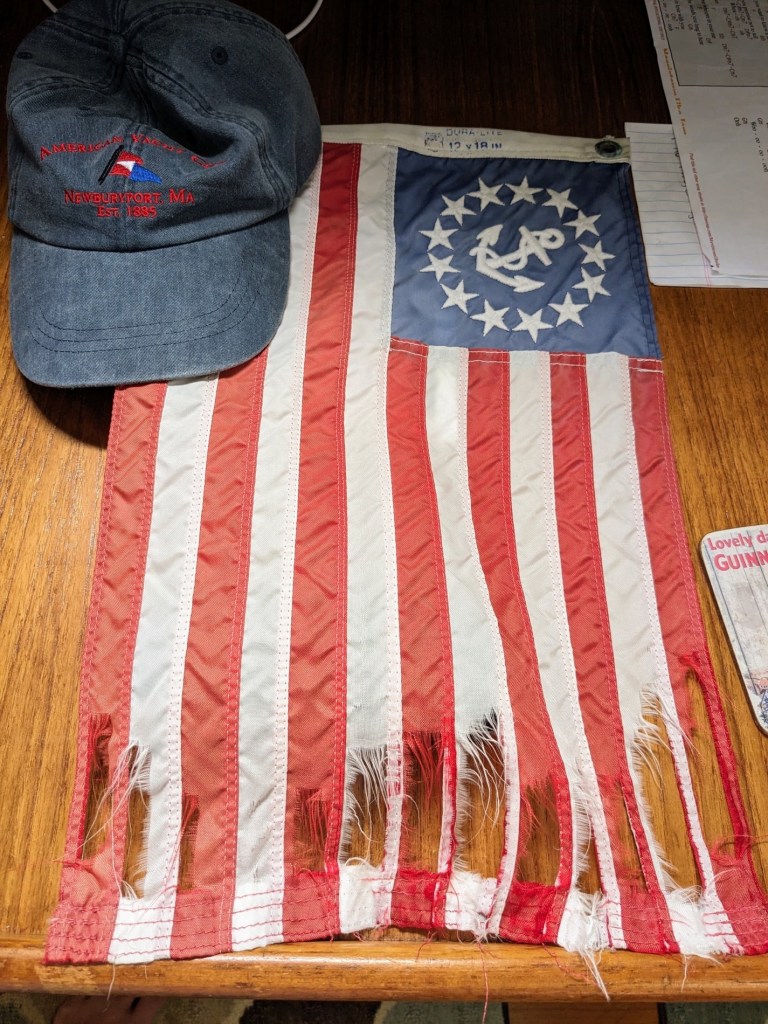
And it’s not just systems spares we carry! Having displayed our origin for several thousand ocean miles, our little flag was recently retired and its replacement hoisted in time for our country’s birthday celebration.
Happy 4th of July!
 SV Fayaway
Glad all is well.
Great lessons to be learnt.
Thank you for sharing!
LikeLiked by 1 person