
Our adventure in the Bahamas left off last time at a rendezvous with fellow Salty Dawgs. Soon thereafter we moved south again to pick up our friend and offshore crew, Chris, at the surprisingly bustling Staniel Cay airport. That afternoon the sun came out so our trio caught a slack low tide to snorkel the Thunderball Grotto, and then began moving north again.
Yep, that’s the actual Thunderball Grotto of the 1965 James Bond namesake movie Thunderball.
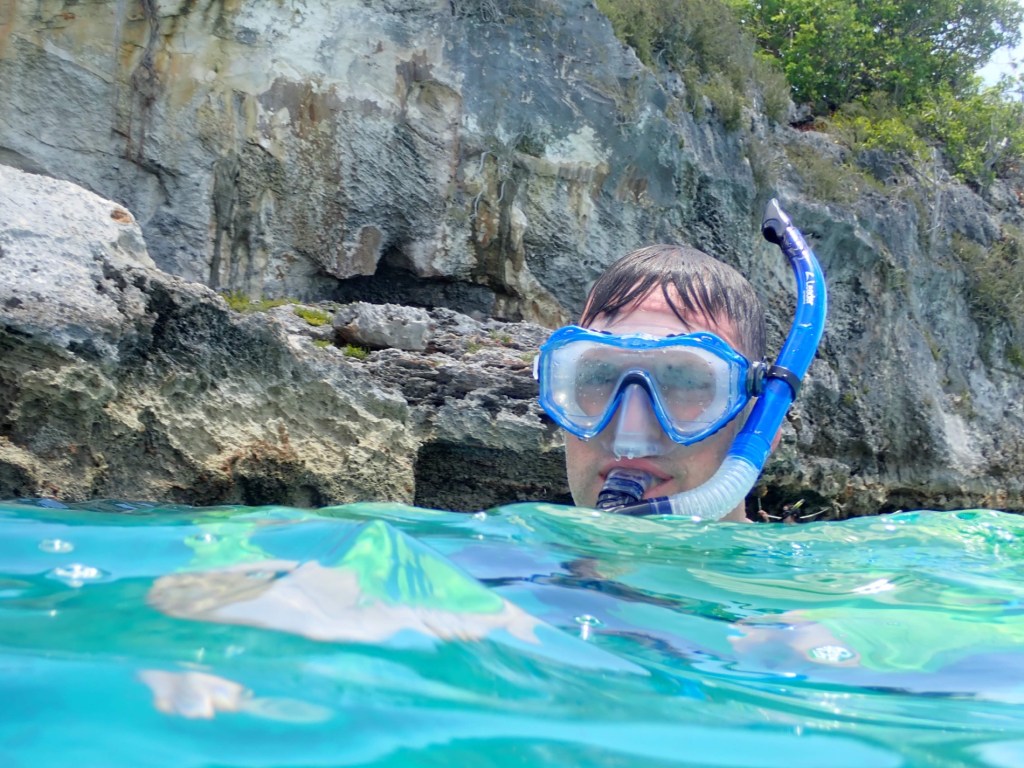
For all our passages Kelly and I have never sailed Fayaway overnight with additional crew! (Prompted by insurance changes). Nor had Chris ever sailed offshore. So we acclimated ourselves with an easy day-hop north to Highborn Cay, and then a single overnight to Marsh Harbor. By that point if anyone was going to bail, this was their last chance.
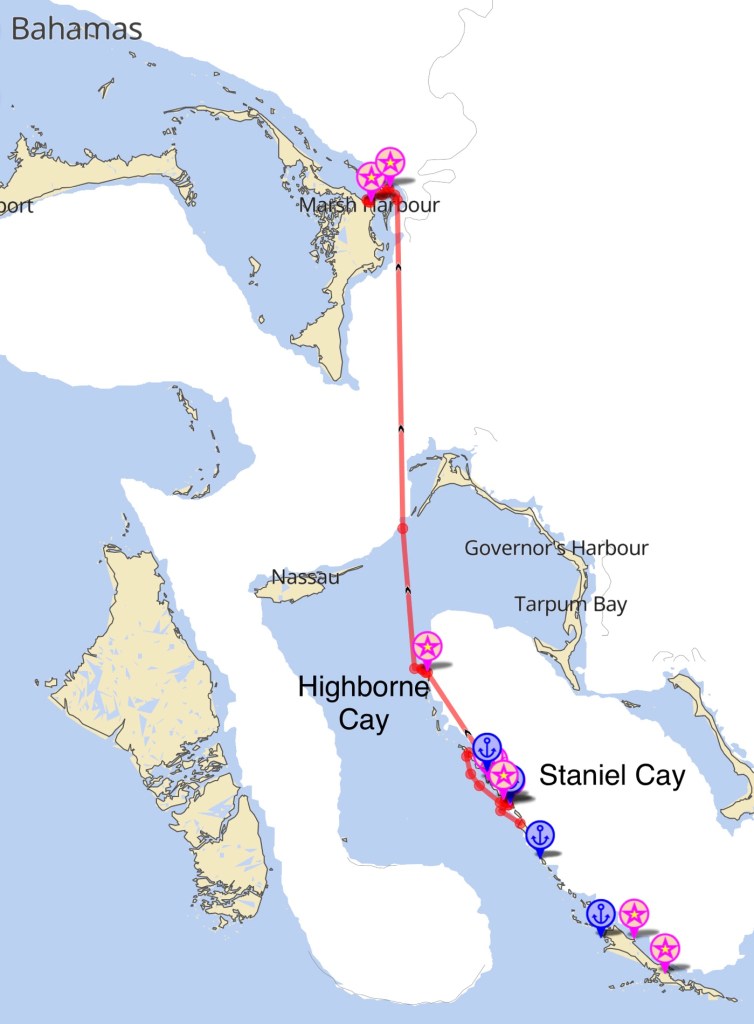
Marsh Harbor debate ensues…
While we weren’t “officially” participating in the Salty Dawg Homeward Bound Rally this year, we were already friendly with so many participant boats we collaborated using each other’s respective weather reporting sources. Via WhatsApp, Facebook, etc, we frequently bounced comments and thoughts back and forth regarding departure plans for our long passage to the frigid northern latitudes. Fayaway’s target was for a quick run up to New England – specifically to our home port of Newburyport, MA. Most other boats aim for the US coast further south, but generally in our direction.
If you know how volatile the western Atlantic has become lately, you also know any direct passage unscathed would be a long shot without running into snotty weather. To make the entire passage in one swoop without getting whacked by a gale would be unlikely. We accepted this, discussed our possible options and set course toward Norfolk, VA, the mouth of Chesapeake Bay. Optimally we’d coordinate rounding Cape Hatteras, gaining a boost from the warm and swiftly moving Gulf Stream, while timing between weather fronts emanating from points west. Easier said than done!

To no surprise, we battled reverse-current (south-flowing) eddies, thwarting our northerly progress, and narrowly missed an opportunity to avoid one big and nasty northerly. Approaching the cape while riding the beneficial Gulf Stream, we reached a decision point: a) Risk rounding Hatteras against a predicted northerly gale. b) Eliminate the risk of being beat up, and commit to motoring through the ICW. c) Sit inside Beaufort area, wait for a future forecast to head back out. So it goes… we’ll get there eventually! (We chose b).
Oriental
Our approach into Beaufort, NC was after a bright dawn and otherwise uneventful. Clearing into Customs is now a breeze with the ROAM app. (Kudos to US Customs and Immigration!) Even before entering the inlet, we were already cleared into the United States. Our first stop was the little town of Oriental, just out of Adam’s Creek and across The Neuse.
First settled in the 1860’s by local fishermen, Oriental, North Carolina had remained very rural and unpopulated until recent times. 4 boats called it their home in 1960. Now it’s closer to 3,000, and home to retired snowbirds and fishermen alike. (Source: townoforiental.com)

We anchored outside the town breakwater in strong breeze and sticky mud, just in time to have dinner ashore with Mike and Mary of Dreamweaver, before sleeping through near-gale conditions that evening. By morning all was calm and pleasant again. We planned an early rise with the sun, but with the change of wind direction overnight, an adjacent boat had swung over our anchor. No problem; I’ll call them on the radio. No answer. Then with a few shouts from Fayaway’s bow, I managed to wake the snoozing couple, and they offered to pull forward as Kelly brought in our mucky chain.. Off we went!
Oriental is on The Neuse, as locals call it. (Actually the Neuse River.) Our next anchorage is on The Pungo. Interesting names don’t you think? Then there’s The Alligator, (Alligator River) and we’ll get to that place too. Interestingly, these large open bodies appear to us more like bays; their “rivers” are also called creeks. I wonder: at what point between southern and northern geography do rivers become creeks, and bays become rivers? At least they still call a Sound a Sound.
Fumes
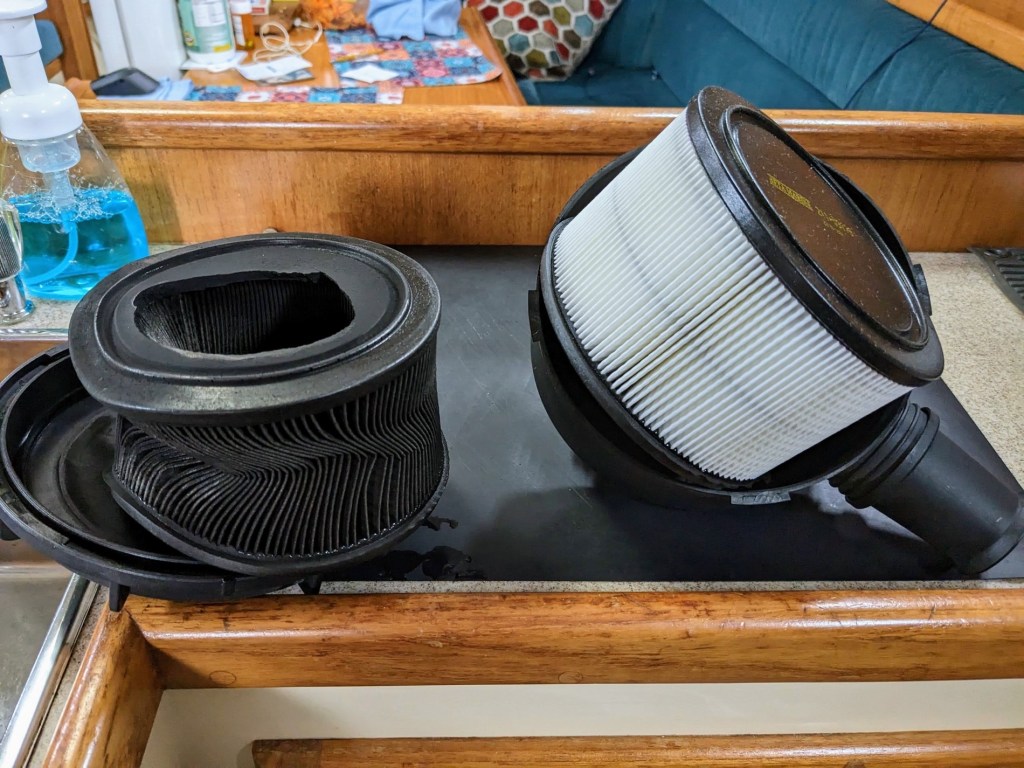
With light headwinds we commit to a long day and fifty nautical miles of motoring up (or is it down?) We travel the Pungo, against mild current , under ominously low bridges. Eventually, just east of Belhaven, we approach a nice spot in the sheltered lee on the north side of the Pungo. I commented all day about something odd: a pronounced diesel exhaust smell, one that usually comes with motoring downwind. But it seemed to bother only me, and we are tired now, the anchor is set, and our cook/crew offers to make fancy rum cocktails to relax our travel tensions.
For timing low tide going under a bridge, we had a couple hours to kill the following morning and so a good time to change the engine oil. Upon opening the engine cover, I noticed quite a bit of dirty soot. Hmmm? Then I quickly found the source of foul fumes… a broken exhaust manifold! Quick! Get the hose clamps and beer can!
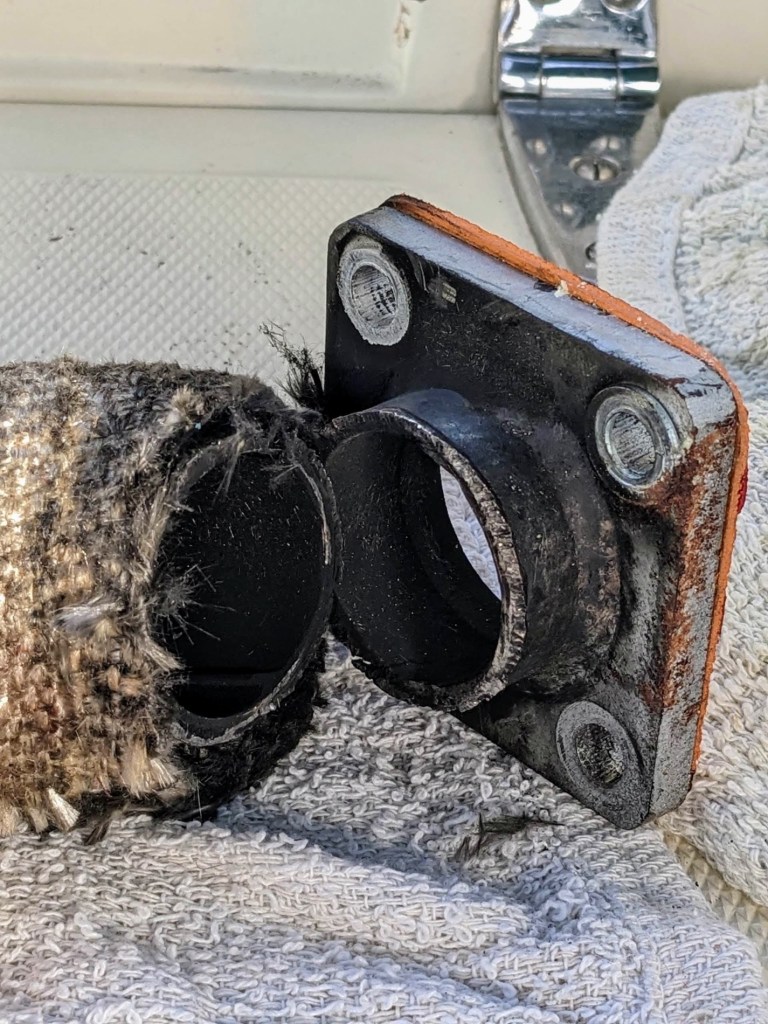
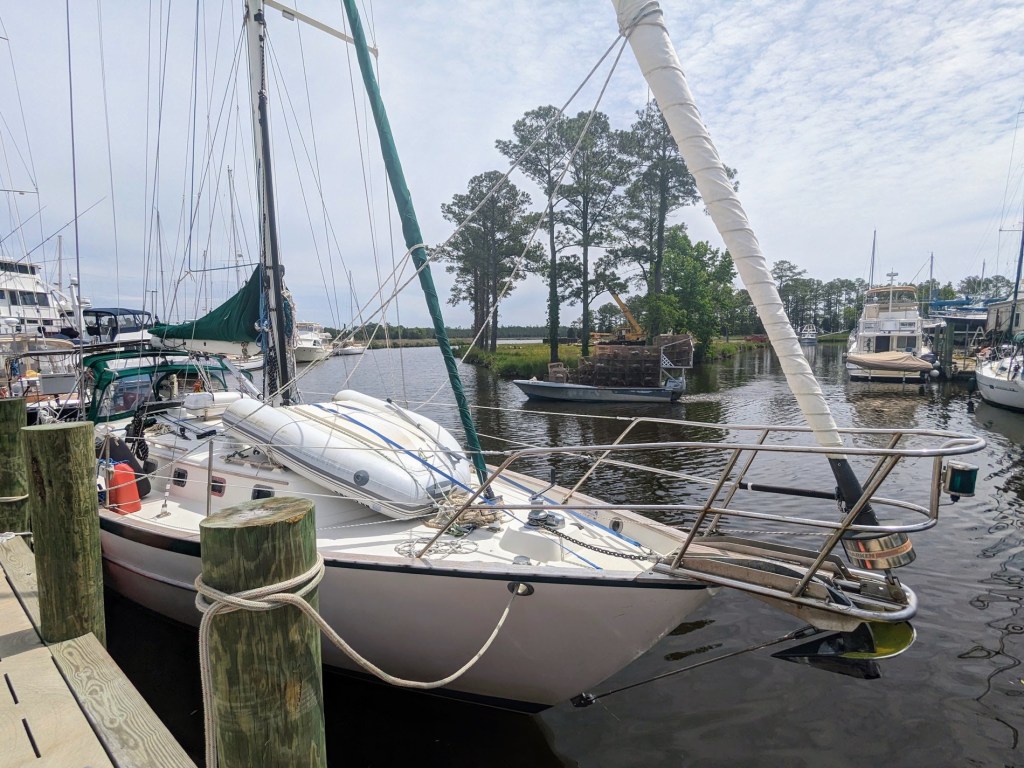
Nah, we were anchored in close proximity to TJ’s Marina in Belhaven, whose owners very kindly allowed us to tie at their fuel dock during repairs. With so many more miles to travel in the coming weeks, it made better sense to take the time for proper fixes.
Goodbye to Crew
Seeing an indefinite delay now for repairs, it was time for our offshore crew, friend, bartender and fantastic cook, to depart. But first we’ll explore the town a bit, and find some food! Thanks again, Chris!
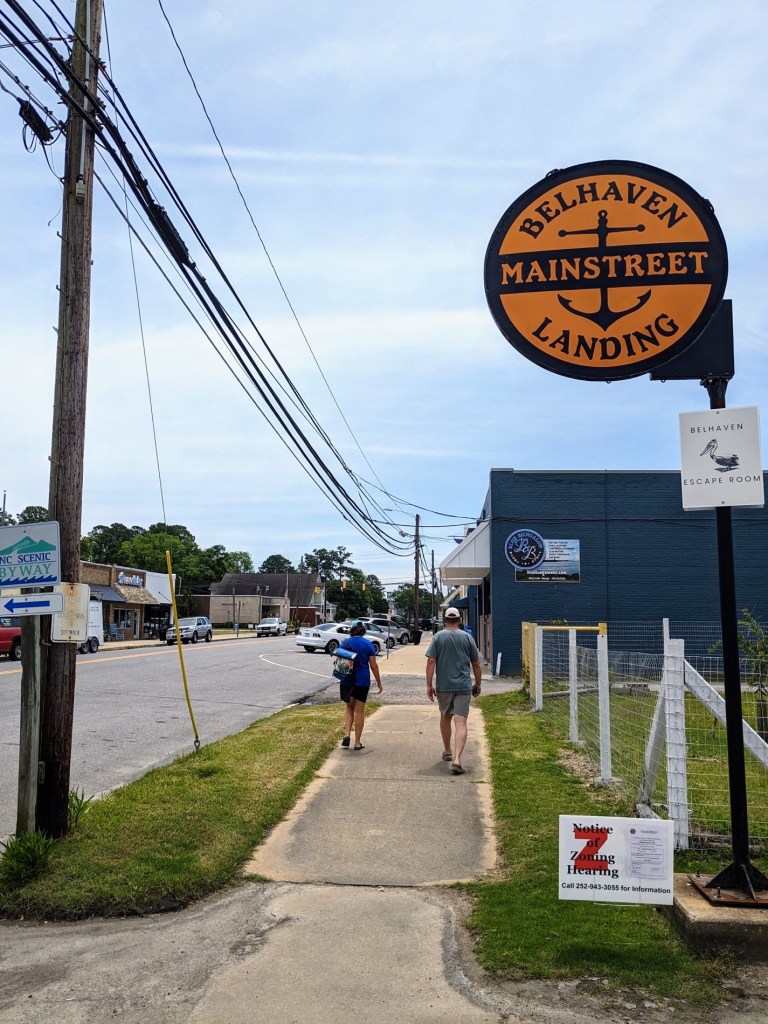
Our remaining stay at TJ’s Marina was notable for meeting several of “the locals”, both around Belhaven, and in the boatyard. Much thanks to TJ and his helpful team to help us get going again.
What’s next? The Alligator River and beyond, on our way to Norfolk and back into the volatile Atlantic. Thanks for reading, and hug your kids!
 SV Fayaway